Monday, October 04, 2021

Any port in a storm


Any Port in a Storm

Any Port in a Storm!

Now that Hurricane Irma has past, I’m riding home to Ft Lauderdale. VocabularySpellingCity is headquartered in South Florida so we shut the office last week and everyone scurried like ants to safety.  In my case, my  “port”  was a dog-friendly motel in Alpharetta, Georgia.

For some reason, this idiom – “Any Port in a Storm” – kept playing in my head like a brain worm.  One reason the expression kept playing is that I’ve been thinking about how we can help students learn idioms and figurative language.

English literacy is a challenge for many reasons, one of which is the constant use of figurative language. The typical elementary student is very literal and can have trouble absorbing some of the metaphors that we typically use. A 2nd grader might “raise their eyebrows” when I respond to a question about whether I like the motel with: “I love it, any port in a storm. I’m not going to look a gift horse in the mouth.”

For ELL students, many American idioms are both obscure references and rely on cultural references that can be hard for them to relate to. Imagine how an ELL student might struggle when the teacher, encouraging her before a performance, says: “You’re on deck, soon up at bat, so get in the zone. I’m sure you won’t strike out.” Would words like that be as clear as mud to a recent immigrant?
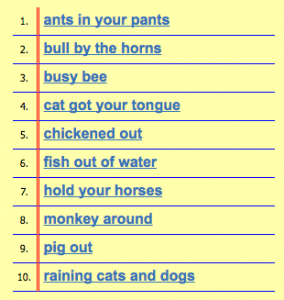
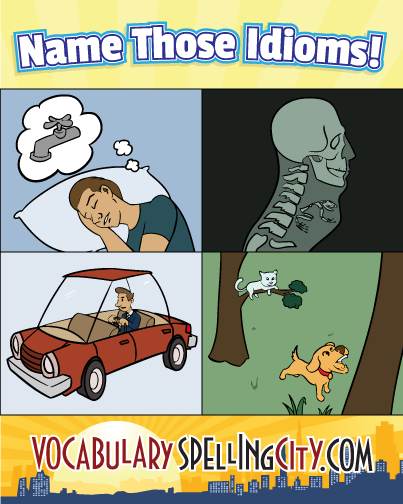
VocabularySpellingCity Animal Idioms

VocabularySpellingCity Animal Idioms

On the other hand, much of our vocabulary has figurative origins that make the words easier to learn and remember if the teacher highlights these origins. For instance, knowing that the word “lousy” originally literally meant “lice-infested” makes ” lousy” a  much more dramatic expression. And on the subject of lice, what other expression derives from dealing with those annoying infestations? (The answer of course is nit-picking. Nits are the little lice eggs that have to be painstakingly picked out of the hair.)

A few things about teaching idioms.

  1. Teaching idioms should be fun. Want an idea: Have a different student each day be responsible for teaching a new animal-based idiom to the class. Once you start to exhaust animal based expressions, you can pivot to sports idioms.
  2.  VocabularySpellingCity can help. Our lists can use not just words, but short expressions (up to 4 spaces are allowed. So “smart like a fox” will work!)
  3. There’s every reason to make a point of out using idioms when talking as long as you take the time to highlight and clarify them.  It also makes sense to have a time during the day when all the students are urged to talk with idioms.
  4. The VocabularySpellingCity teaching resources includes preconfigured figurative language lists of several types:

Hyperbole – exaggeration used to emphasize a point or to add excitement or humor. Examples:
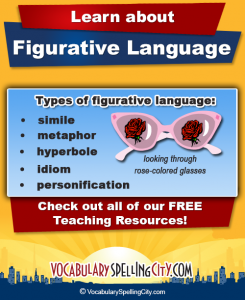
Figurative Language Types

Figurative Language Types

  • I can smell my mom’s brownies a mile away.
  • I have a ton of homework.
  • I’ve seen this movie a thousand times.

Idiom – expression in which the intended meaning is different from the literal meaning. Examples:

  • Don’t judge a book by its cover.
  • It’s raining cats and dogs.
  • Who let the cat out of the bag?

Metaphor – direct comparison between two dissimilar things.Examples:

  • Her voice was music to my ears.
  • You are my knight in shining armor.
  • Snow covered the streets in a white blanket.

Personification – literary device used to give human characteristics to nonhuman objects. Examples:

  • The palm trees were dancing in the wind.
  • The carved pumpkin smiled at us.
  • The car’s engine coughed its last breath.

Simile – comparison between two unlike things using the word “like” or “as.”  Examples:

  • The teenager is as hungry as a wolf.
  • The old man is as wise as an owl.
    Guess that Idiom #1

    Guess that Idiom #1

  • The new dad is as proud as a peacock.

And as icing on the cake, I’ll point out the figurative language materials on our site are correlated to each state standards (also to Canadian and Australian standards). Using the CCSS a starting point, proficiency standards are defined as of 3rd grade.

Common Core State Standards Related to Figurative Language

CCSS.ELA-Literacy.L.3.5
Demonstrate understanding of figurative language, word relationships and nuances in word meanings.

CCSS.ELA-Literacy.L.3.5.a
Distinguish the literal and nonliteral meanings of words and phrases in context.

CCSS.ELA-Literacy.L.4.5.a
Explain the meaning of simple similes and metaphors (e.g., as pretty as a picture) in context.

CCSS.ELA-Literacy.L.4.5.b
Recognize and explain the meaning of common idioms, adages, and proverbs.


One of the most exciting things about teaching idioms is that each student can research idioms around their own interest: animals, cooking, sports, and so on.

So is teaching idioms as easy as pie?  Do you know your  types of idioms like the back of your hand?  With this head start, are you ready to knock it out of the park with your teaching?  Don’t be a stranger, tell me what you think. Comment below, tweet to me @VSpellCityMayor, or Facebook me on our Facebook page.

I'm sorry... Said the teacher about the English Language.


The English Language is Impossible

The English language is hard partially because of some ambiguities in key terms that are used daily. There are words that are just confusing.

Worst of all in my opinion is the word “sorry”.

I’m Sorry

The phrase “I’m sorry” can mean dramatically different things that are easily confused. 

At a funeral, I might say “I’m sorry” to express sympathy or empathy for the person’s loss. But it’s not an apology or admission of guilt. I’m not suggesting that I caused the death.

If I bump into someone on a crowded bus and say “I’m sorry”, it is a sort of apology or at least a recognition that I take some responsibility for the minor mishap. At least, I acknowledge that I regret that this happened even if I’m not assuming responsibility.

However, there’s also the true expression of regret and guilt as in when I ate all the cookies when Mom had said I was only allowed to have one. Busted by Mom, I’ve been shamed and am apologizing to my hungry and cookie-less siblings with “I’m sorry”.  This was an actual admission of guilt, blame, and regret. To this day, I feel guilty about pigging all the freshly-baked cookies that one time!

Back to Education

How is a teacher supposed to get her elementary school students to understand these nuances of meaning when such a critical word has such a range of frequently confused meanings?

I think the answer is to model precise use of language and then to start asking your students to do the same. If a student uses “I”m sorry” in a confusing way, a teacher can ask saying: “Are you just expressing sympathy for an unfortunate situation or are you accepting blame, stating regret,  and resolving to try not to repeat it?”  Of course, in the context of an elementary classroom, that would be harsh and not fully appropriate but I think you see the idea.

Real World Modelling of Being Precise with Words

As a more realistic example, a teacher could say to her students, once an ambiguous word is used: “I’m sorry that English is so hard to understand.”  Then, the teacher could ask the class if they felt the teacher was:

A: Saying it is regrettable that English is so hard
B:  Taking responsibility personally for having created the complexities in English
C: Both of the above

Like many multiple choice class questions, this can be discussed and then people can either vote either by a hand count or having three places in the room to go to be vote and be counted (this is more engaging for many young students and helps avoid having them sit still for too long a time).

Modelling Speaking Precisely

Personally, I could avoid saying that “I”m sorry English is so hard to understand” since it’s ambiguous if I’m taking responsibility or not for the regrettable peculiarities of English (Perhaps as mayor of VocabularySpellingCity I do have some complicity). 

Instead, I should say: “It’s a shame that English is so hard to understand.” This way it’s clear that I’m expressing sympathy for the teachers and students’ heavy burdens without suggesting that I have any guilt or complicity in it.  But in addition to speaking precisely, it’s better pedagogy to explain to everyone why we are choosing the words that we do.

Thursday, June 10, 2021

Fun Learning and the Pandemic

 There are currents and counter currents. Overall, students did worse as measured by standardized tests. Especially in math.

But, many students learned faster and better and flourished in remote learning. Many kids switched to homeschooling and seemed happier. At the pandemic outset, 4% of the US K12 population was being homeschooled. Most recent Census homeschooling data says that over 10% is being homeschooled.

 True educational games have done great in the pandemic.  Time4Maths which is a great math set of games organized and managed so that they build true math facts fluency and  proficiency while the kids are simply playing. Great example of true game-based learning.  For more info on a fun, effective way to build your child’s skills in math, look at the links below.

Time4MathFacts is an online program that helps students practice and master their math facts in addition, subtraction, multiplication, and division. Whether your child is struggling in math or beginning to learn their math facts, Time4MathFacts can help them reach their goals and boost their confidence.

Addition Facts Practice

Subtraction Facts Practice

Multiplication Facts Practice

Division Facts Practice


Monday, March 01, 2021

test of wonder of the day widget

This is a test of the Family Literacy Wonder of the Day:


https://wonderopolis.org/widget/blogger here's the iframe version....

Saturday, December 07, 2019

The Phonics Patent


Even as we rolled out SpellingCity, teachers and literacy coaches asked us to provide the same flexible practice tools to focus not just on spelling but on recognizing and working with sounds.  They asked for help not just with the spelling of words but with learning phonics and building phonological skills.  So we decided to help students construct and decode words by working with the sounds and the letter blocks that represent them. 

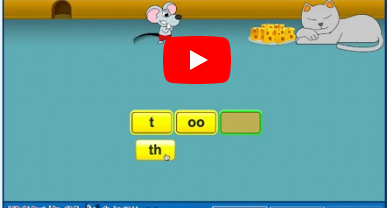
The idea was simple: We wanted to treat words like “tooth” as three blocks of letters which correspond with the three sounds: T, OO, and TH. But, as we searched, we could NOT find a system which mapped the sounds in words to the way the words are spelled. At first, this seemed unbelievable. Surely, in some university or research center, somebody had created a mapping which connected all the common English words into their sounds and mapped those sounds to the letters used to spell the words.
We spoke to a lot of people which  confirmed our initial findings. This mapping did not exist. Dictionaries, for instance, routinely have a phonetic spelling of words using various systems for writing phonics. But none of the dictionaries mapped the sounds back to the actual spelling of the words. Nobody had ever done this.
Our vision came from watching endless tutors, teachers, and parents help students by pointing at a few letters in a word and having the student say the sounds that those letters created. We watched teachers help students read the sounds to decode the word and then blend them together to write them.  

So, we decided to create the VocabularySpellingCity Phonics system, a novel contribution to literacy. The phonics system can be used for building a variety of prereading phonics-related skills including phonological skills, phonemic awareness, and spelling skills. Since we knew we had created something original and valuable, we started talking to lawyers. We decided in 2015 to file for a patent on our original system.  We started with two provisional patent filings.
Our permanent patent is number 10,387,543, issued on August 20th, 2019. It’s called a “Phoneme-to-Grap
hemes Mapping Patent”. It’s a utility patent covering our original method for algorithmically mapping the sounds in English words to the letters. The patent grant is both a recognition of novelty, a recognition of usefulness, and a grant of intellectual property ownership.
What is Phoneme to Grapheme Mapping?
Phonemes are the basic sounds of the English language.  Examples of phonemes from the word “cheek”, would be: CH, EE, K.   

Graphemes are the use of letters to express these sounds.  In English, here are three different patterns of how sounds (phonemes) are expressed by letters (graphemes):
  1. Some sounds are created by a single letter, for example, the T is “ten”.  T almost always sounds the same (unless it’s in a combination with another letter like H).
  2. Some sounds such as the long E sound can be spelled a number of ways including a double E, an E followed by an A, an E followed by a consonant followed by an E which is at the end of a word, a y at the end of the word, and an EY at the end of the word.
  3. Some letters, like the S, can usually sound one way, like in sound, and sometimes sounds quite different, like in sugar (where it makes the SH sound)
So how can this technology help?

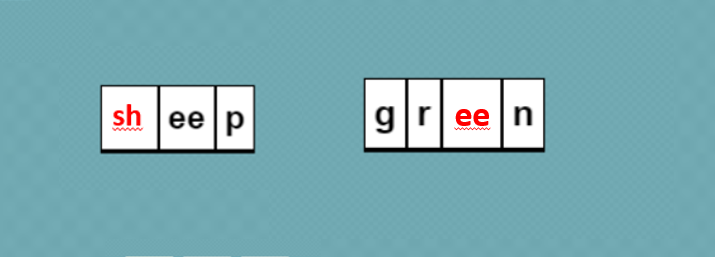
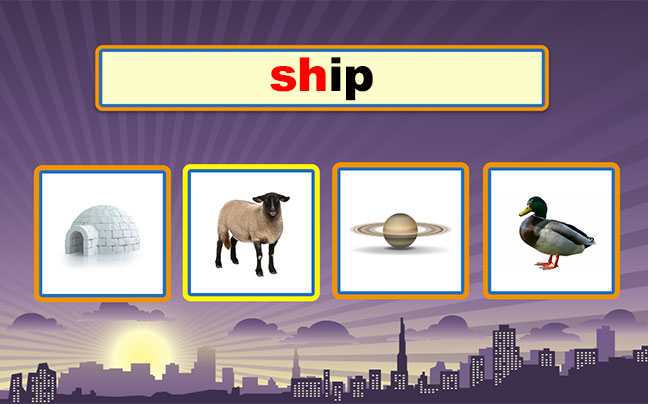
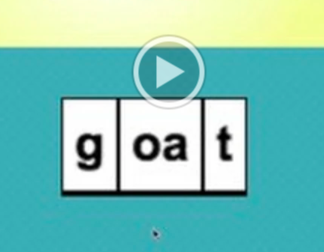
Students can hear and see the sounds by mousing over the sounds in each box of VocabularySpellingCity’s Interactive Phonics Boxes. Many classrooms have students first work on recognizing the initial sounds where the Sounds Boxes are used with images to match initial sounds.
The patent holders who are current VocabularySpellingCity employees are John Edelson, Obiora Obinyeluaku. and Kris Craig.  For commercial purposes, the patent belongs to VocabularySpellingCity.
Patent 10,387,543
Holders of Patent 10,387,543 (current employees)
Activities with Interactive Sound Boxes (that use this technology): Sound It Out,  Initial Sound Speller, Final Sound Speller,  FlashCards, Word Study (available for logged-in students) and TeachMe More.
Study and TeachMe More.

John_Edelson
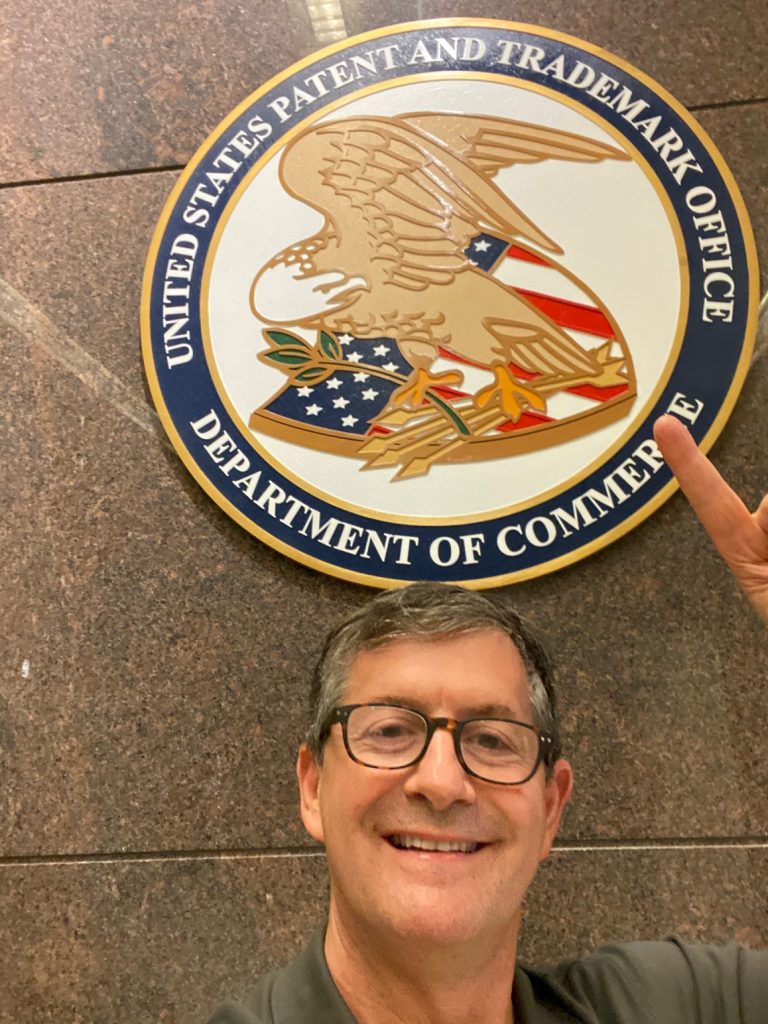
John Edelson at the US Patent Office
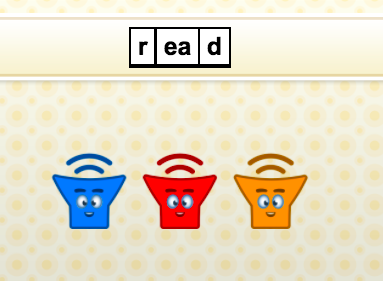
Sound Counter
The Sound Counter Helps Students Focus on Distinguishing Sounds, Building Phonological Awareness

Tuesday, August 13, 2019

Blogs Remain Special

Even with the social media of today, there remains a need for education through long form posts. Look, Twitter and Instagram and even Facebook are great for seeing a flow of ideas and headlines but they aren't good with substantative content, this is why blogs continue to reign as the only way to have deep materials.

Admittedly, both Facebook an dLInked In have built a sort of onsite blog for articles. This sort of works. But each article is isolated and there's not a canon of work with tabs and themes the way that one can get on a blog.

Teachers often find the indepth info that makes a huge difference to them thru these blogs.
And blogs help with people finding people. Here's info on education for Jennifer eaton.

Friday, June 28, 2019

Tech is NOT transforming education...

I was just reading the Why Tech is not transforming Teaching and I feel that all of those thoughts and opinions are too mired in the details of school management to see the forest.  They are just seeing the trees.  A few points:

<sadly, this article is a work in progress. Want to help me finish researching and writing it? Comment here and I'll get back to you>

Almost every industry has been transformed by education with vast ongoing increases in productivity. Farming, manufacturing, retailing, communications, health care, and even government.  Education's slow movement has to do with some funny things about how schools are managed, not by any limitations of what technology is available.

While they might be right that tech has not transformed teaching, it has absolutely transformed learning. <Higher IQ, astonishing spatial reasoning and hand-eye coordination> and a flip side that kids can no longer read maps.

Technology has transformed the kids: the kids of today are wired quite differently.
Technology has transformed the skills that the kids need to succeed when they graduate. Need to be more entrepreneurial, higher lever skills, more tech skilled. The highly repetitive disciplined jobs of yesteryear which we use to train people for: GONE!

Big picture: I love the story of the big foundation study in the last year which did a broad state of education study and found that the students were .... <drum roll> .... very bored by school. From late elementary school through the end of high school, students across the spectrum and country reported school was dull and didn't feel relevant or important except for the credential.

The study followed up by looking at  the nation's so called innovative schools and found... the same thing!  They then took a closer look at the data and found a countertrend. In every school, including the conventional ones, there was a streak of high interest activities.  What were they?  Well, we all know the answer and its sort of amazing that this doesn't have a higher profile in our discussions about education.... It's the electives and supplementary programs.   The robotics program, the coding program, the theater program, the music program, the school newspaper, and of course, sports. 

So how to think about education and the impact of technology. 
Personalized:
- if you are black, do you care about a US history text book in which the first half of the book is all those white dudes and the only blacks are details about the start of slavery?   Why not ask them to create real US history which shows how they got here? Their history.  The research on this is that it produces highly motivated students plus much better mastery of US history as measured on conventional tests....


Wednesday, April 04, 2018

Elementary Writing Program

WritingCity is our new writing program, I'm real excited about it.  I saw this blog post about how it serves as a great elementary writing program. 

And I'll quote a little:

WritingCity, previously WriteStepsWriting, provides:


  • detailed day by day lesson plans
  • the authentic student writing samples as examplars
  • the videos so the mini-lessons could be done in literacy centers rather than in whole class sessions by the teacher
  • The blending of key writing strategies including Writer’s Workshop, 6 Trait Writing,   Bloom’s Taxonomy, Multiple Intelligences, Marzano’s Instructional Strategies, and Cooperative Learning
  • The balance of using prompts that are response to reading versus more open-ended prompts


  • Teaching writing of course is very difficult in elementary schools since the teachers aren't dying to spend time reivewing the kids writing and the kids aren't always that excited about struggling with sentences. But getting them writing early is always a great idea.

    Thursday, February 22, 2018

    Learning to Write

    There are many approaches to learning to write but let me discuss a few here. The Writers Workshop, pioneered at NY Colleges, is real popular. The idea is that there's a little mini lesson and then, wahoo, lets each write.  It's about writing.
    Lucy Caukins is often the prof most associated with taking WW into the K12 population.  The most popular current effective implementation of Writers Workshop is WritingCity.

    Settings for Handwriting Practice
    Anotehr approach is for students to take single courses where they get minilessons and then practice specific isolated skills. Works for many kids. For this, use Time4Writing! here are some great materials from Time4Writing;

    Lastly, do not forget that there is an important role for handwriting worksheets to practice developing handwriting skills, particularly in early elementary.

    Sorry dear reader about the fonts. It's too hard to sort out. Sigh.


    Wednesday, November 08, 2017

    Speedy Speller!!!!

    Ask any elementary student about their favorite spelling game and in any grade, you'll hear about Speedy Speller!!!! Play it here! NOW!


    Thanks VSC: Want lists by great?  HERE!


    1st Grade Word Lists
    2nd Grade Word Lists
    3rd Grade Word Lists
    4th Grade Word Lists
    5th Grade Word Lists
    6th Grade Word Lists

    Friday, September 15, 2017

    Wonderopolis and Family Literacy

    I've just been talking to John R at Family Literacy - NCEL - in Louisville Kentucky about Wonderopolis and WonderoCity. Community manager is John M. Impressive board.. Here's one of their widgets:


    https://wonderopolis.org/widget/blogger
    - doesn't activate...
    It's a very impressive collection of educational materials. Their mission is to provide support for family literacy.  They have:

    Wonders of the Day -
    Wonderground - exchange on what to do with it
    Camp Wonderopolis - sometimes overlaps with Wonders of the Day
    Wonderwall

    So much very cool and well done educational materials.
    https://wonderopolis.org/
    Interactive Wonder Jar
    Family Literacy - NCFL!

    Thursday, September 07, 2017

    Hurricane Education

    Here's my favorite, the hurricane song.


    Hurricane Spong
    The Hurricane Song


     Here's a new one that I just discovered. How much does a hurricane weigh? Sound stupid but it's amazing. It first deals with the question of how much does a typical fluffy cloud weight (Spoiler alert...tons!)


    This little film has some good content but the dramatic premise is laughable.

    Hi Timmy. Your house is gone. I'll teach you some science about hurrricanes....

    It does have a few dramatic music sequences which make up for the cheesy premise. Also, it's got a great British  voice over.


    BTW. I'm looking at hurricane info since I'm an evacuee from IRMA in Ft Lauderdale.
    Here is the info on evacuation zones in Ft Lauderdale.

    Flex tape - here's the ad from TV about this amazing tape. If I'd had time, I wanted to seal up my sliding doors at the seam and see if it would actually stop the house from flooding. Anyone know if it would?  I asked them in the comments of their youtube video, I wonder if they'll answer...

     https://www.flexsealproducts.com/product/flextape_giant/


    Wednesday, August 30, 2017

    Have you ever wondered?

    Here is a stream of more than just fun facts, these are areas of mystery demystified for us. Enjoy! All thanks to Family Literacy Center in Louisville and Wonderopolis. 

    Monday, August 28, 2017

    First Palm You'll See Driving South on I95?

    Here is a valuable update on the first palm trees seen from driving south on the I95 highway. Sorry, still no pictures or a Google address ID. I might get onto Google Earth and try and figure it out!